Pudhugai Thonmai
Pudhugai Thonmai

By
Naveen Balaji M R
PDGMS
Pudukkottai
INTRODUCTION
Pudukkottai was founded by Raghunath, raja of Tondaimandalam (the region around the ancient port of Tondi on India's southeastern coast). Industries include peanut (groundnut) oil and sesame oil extraction. The city is connected by railway to Tiruchchirappalli and Thanjavur as well as to Madurai to the southwest.
Pudukkottai's Historical Features
Porpanaikottai ( Archeological site )
Sittanavasal
Thirumayam Fort
Aavudaiyar kovil
Kudumiyanmalai
Naarthamalai
Explore........
Let us start with Our District's Archeological site
Porpanaikottai

According to the Archaeology Department, studies have indicated that
the fort was spread over an area of 17.75 hectares with three entrance
gates. The northern side entrance has brick walls on both sides. A
habitation mound spread over 1.26 hectares with continuous settlements
from the Iron Age is believed to have existed within the fort. Iron Age
burials, black-and-red ware and early historic bricks have been
recovered from the site.
“The earliest lithic evidence in the form of a memorial stone datable to 3rd - 4th century CE, on the palaeographical ground, emerged from this site. It looks contemporary to the Pulankurchi inscription. The memorial stone was raised for a hero Kanankumaran, a soldier of the close circuit, who died in a cattle raid carried on this village by Ponkongar Vinnakon. The ruined fort was probably built in the 13-14th century CE,” said a note issued by the Archaeology Department.

“It is a huge fort all around, the present size of the fort … and according to tradition, it had 32 bastions. Inside, one could notice the remnants of the buildings probably a palace of the chief. Evidence of temples at four cardinal points have been found. An iron slag mound lies on the southern side near the fort,”
Sittanavasal
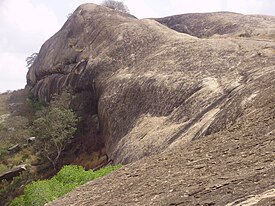
Sittanavasal Cave (also, Arivar Koil) is a 2nd-century Tamil Sramana complex of caves in Sittanavasal village in Pudukkottai district of Tamil Nadu, India Its name is a distorted form of Sit-tan-na-va-yil, a Tamil word which means "the abode of great saints" (Tamil: சித்தன்னவாசல்).
The monument is a rock-cut monestery or temple. Created by Tamil sramana it is called the Arivar Koil, and is a rock cut cave temple of the Arihants. It contains remnants of notable frescoes from the 7th century. The murals have been painted with vegetable and mineral dyes in black, green, yellow, orange, blue, and white. Paintings have been created by applying colours over a thin wet surface of lime plaster.
The Sittanavasal Cave are listed as one of the Adarsh Smarak Monument by Archaeological Survey of India
Paintings
The decorative paintings in the ceiling of the sanctum and ardha-mandapam of Aravirkovil though compared to the classical cave painting styles used in the Ajanta caves but have minor variations in use of the materials for creating the paintings and also reported to provide a link between the Ajanta paintings (4th–6th century AD) and the Chozha paintings of 11th century at Thanjavur


The ceilings have depiction of a lotus tank with natural looking images of men, animals, flowers, birds and fishes representing the Samavasarana faith of Jainism. The pillars are also carved with dancing girl and the king and the queen.
As a tourist place ,
As per Ministry Of Tourism of INDIA Sittanavasal was the place where foreign Tourists Visits the most in their Heritage tour .

Thirumayam Fort
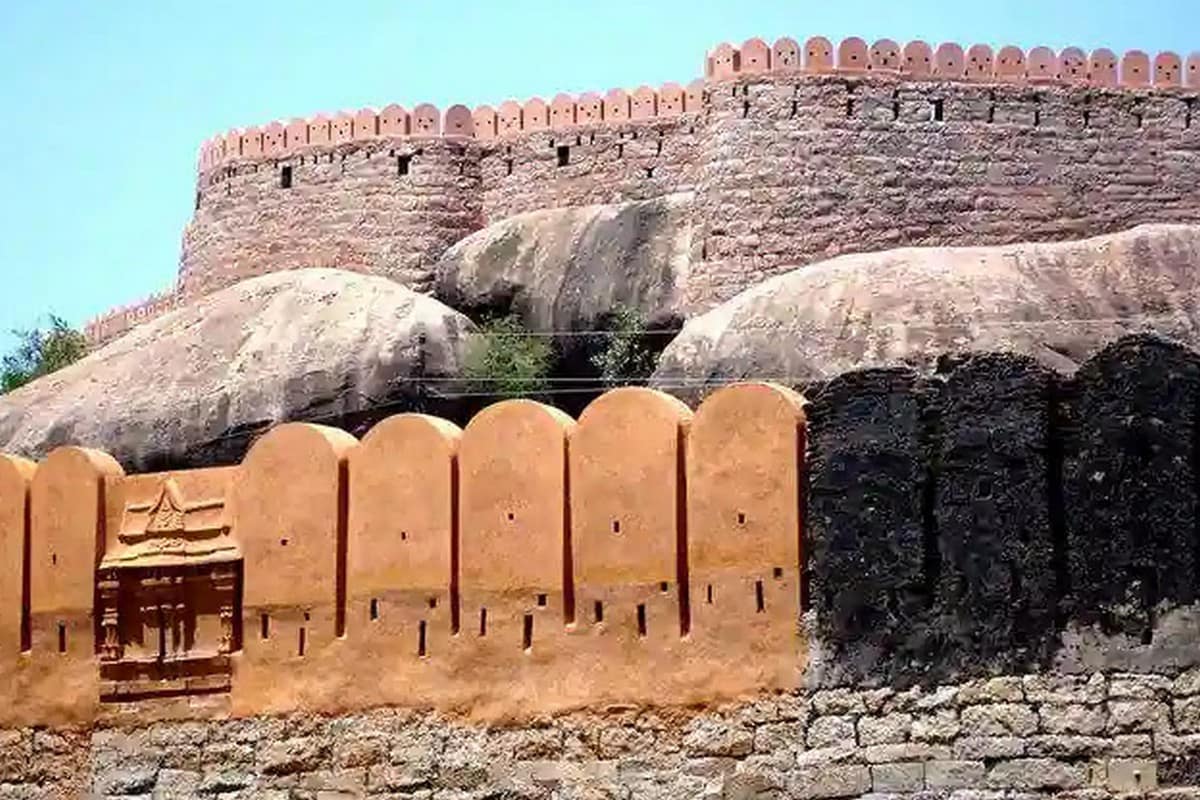
The Thirumayam Fort is a 40-acre wide fortress in the town of Thirumayam in Pudukkottai-Karaikudi Highway in Pudukkottai District, Tamil Nadu, India. It was constructed by Vijaya Raghunatha Sethupathi, the Raja of Ramnad in 1687. Later the fort was handed over to his brother in law Raghunatha Raya Tondaiman.
Architecture
The fort originally said to have been a 'ring fort' with seven concentric walls has only four surviving now. The construction of the fort is of inferior quality as small blocks of stone were used along with bricks for the building of the fortification.

The fort has three entrances; one on the north, another on the south and third on the east. The shrines dedicated to Hanuman, Sakthi, Ganapathi, Karuppar (guardian deities of the fort) are noticed on the southern side and shrine to Bhairava on the northern side. Halfway to the top on the right side a chamber which was used as magazine was noticed. Opposite to this chamber on the western slope of a boulder is a rock cut cell containing a linga on yonipitha, the spout of which is supported by the figure of a dwarf.

On the top of the rock is a bastion with cannon of British origin. To the south of this Platform is a natural pond. On the southern slope there are two rock cut temples, one of them dedicated to Sri Sathyamurthy-Sri Uyyavanda Nachiar (Vaishnavite) and another to Sri Sathyagireeswarar-Sri Venuvaneeswari (Saivite), Which are historically and religiously more important. To the northwest is another pond and to the southeast another tank. There are six more cannons mounted in the north, south and east gates.
Historical importance
IT is of great historical significance and was an important stronghold of rebel chieftains in the Polygar wars .Oomathurai, the brother of Panchalankurichi chieftain Kattabomman was captured in this fort. The fort is locally known as Oomayan Kottai(fort of the dumb)The fort is maintained and administered by the Archeological survey of INDIA as a ticketed monument.
Aavudaiyar Kovil
Avudaiyar Koil temple is located in the small town named Avudaiyarkoil, which is around 14 kms from Aranthangi city of Pudukkottai district in Tamil Nadu state, India. The temple attracts hundreds of devotees and tourists daily. Avudaiyar Koil temple is attractive not only due to spiritual reasons, but also due to its architecture and sculpture. The entire Avudaiyarkoil town has been declared as 'heritage town' by the government. Even though the temple is famously referred as Avudaiyar Koil, the name of the temple is Athmanatha Swamy Temple. The original temple is believed to be built by Manickavasakar in the 8th century AD.

Auvudaiyar temple is very different from other temples.There is no idols for God Shiva as well as for Goddess .In shiva sanctum sanctorum, square type Auvudaiyar is there.No bana linga.Three lamps are lit behind Moolasthana .A white , red & green lamps.white representing Sun, green as Moon & Red as Agni(fire).Goddess Parvathi is called "Yogambal".She ,after attending his father Dakshan's yagna jumps into the yagna fire .She is also formless, comes here & doing penance to reunite with God Shiva.Her Sannidhi is always kept closed.Devotees can see her feet (திருவடி) through a mirror kept inside.During festival time, only the idol of Manickavasakar is mounted on a bull (ரிஷப வாஹனம்) & taken in a procession. As both this saint & Shiva are one, here for Aani thirumanjanam, & Margazhi thiruvathirai festivals only Manickavasakar is decorated & taken around.
Kudumiyanmalai
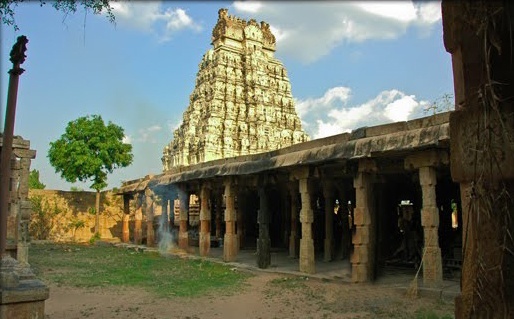
The Kuduminatha temple is built around 10th century by the Cholas. It was later extended by the Pandyas and Vijayanagar Kings. The temple has a thousand pillared mandapa. In the mahamandapa, the sculpture of Narasimha tearing out the entrails of Hiranayakasipu captures attention.
The temple property was auctioned in 13th century, Thiru-k-kaariyaan
Magal Umaiyal Nachiar, a temple dancer, bought it and transferred
ownership back to the temple. She later built the Soundaravalli Amman
temple, near the cave temple. The famous musical inscription describing
notations for the seven-stringed musical instrument 'Parivadini' is
engraved to the right of the cave temple. The mahamandapa attached with
the structural temple has exquisite pillars and portrait sculptures of
Nayaka period.
Naarthamalai
As per some accounts, the temple is believed to have been built by the first king of Medieval Cholas, Vijayalaya Chola (848- 891 CE), but the view is highly debated. As per the inscriptions, immediately after the construction, the temple was damaged by rains and lightning.

Historical Importance ,
During the period of chozhas ( Rajaraja 1 ) Granite stones were carved from Naarthamalai To built Thanjavur Big Temple ( Brahadheeswara temple)

There is a thin forest surrounding south-east part of the region and hence it comes under the forest reserve area. As per a mythological legend when Hanuman was carrying Sanjeevani hill, few shrubs fell over this part of region making it famous for a variety of magic shrubs. A legend stated in Perungalur Sthala Puranam states that the name Narthamalai is derived from the sage Narada, and calls it Naradar malai.
Comments
Post a Comment